
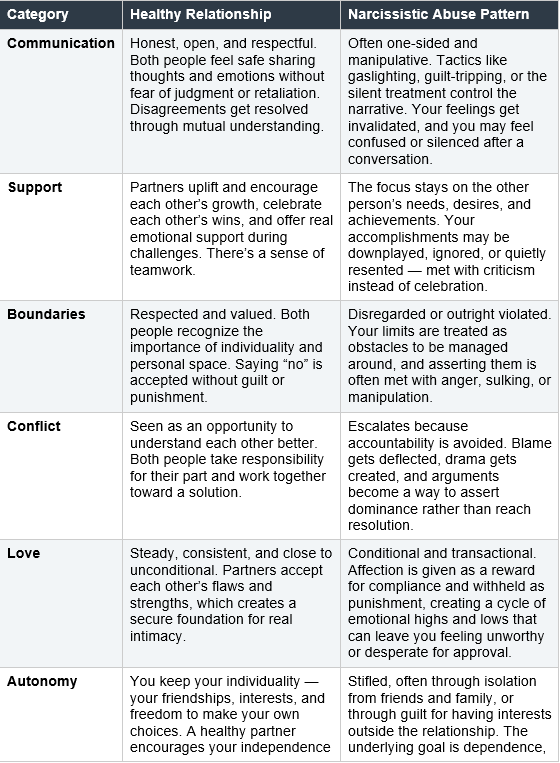
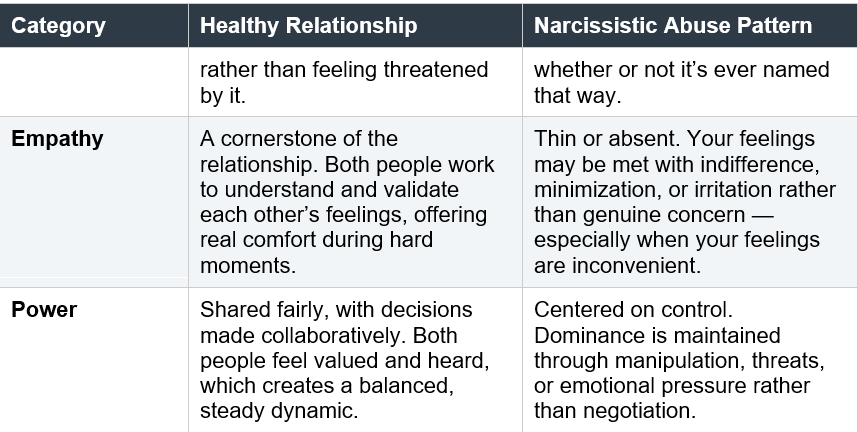
In the last post, we walked through 10 early red flags of narcissistic abuse — the small, easy-to-explain-away moments that add up to a pattern. A question that often comes up next is simple but not always easy to answer: what does a healthy relationship vs narcissistic abuse actually look like, side by side, in the same situations?
It’s a fair question, because both can involve real affection, real effort, and real hard days. The difference isn’t about who has flaws because everyone does. It’s about how communication, support, boundaries, conflict, love, autonomy, empathy, and power actually get handled when they show up. Below is a category-by-category comparison across all eight areas.
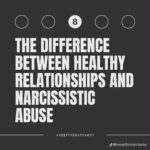

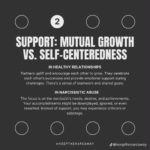

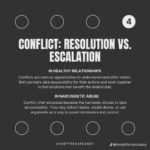


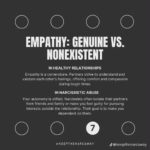

Why This Comparison Matters
It’s worth saying clearly: no relationship is healthy in every category, every single day. People get tired, stressed, and short with each other. What matters is the pattern over time, not any one hard week. In a healthy relationship, the hard weeks are the exception and get repaired. In a narcissistic abuse pattern, the hard weeks are closer to the norm, and “repair” usually means you doing most of the adjusting.
It also helps to notice how the categories reinforce each other. A relationship low on empathy is also likely to be inconsistent on support and love, because all three come from the same root: a limited capacity, or willingness, to prioritize someone else’s well-being alongside your own. Seeing the categories together, rather than one at a time, is often what makes the overall shape of the pattern click into place.
If You Recognize More of the Right Column Than the Left
That recognition isn’t a verdict on the other person’s character, and you don’t need one in order to take your own experience seriously. It’s simply useful information — about what you’ve been navigating, and about where you might want more support, clearer boundaries, or more space to think things through.
If this comparison brought language to something you’ve been sensing for a while, you’re not alone in that, and you don’t have to sort it all out at once. Understanding the pattern is a process, not a single moment of clarity, and you’re allowed to move through it at whatever pace feels survivable to you.
As you read back through the table, it can help to think of a specific recent moment for each category — an actual conversation, an actual disagreement — rather than staying in the abstract. Patterns are often easier to recognize in a memory than in a hypothetical.